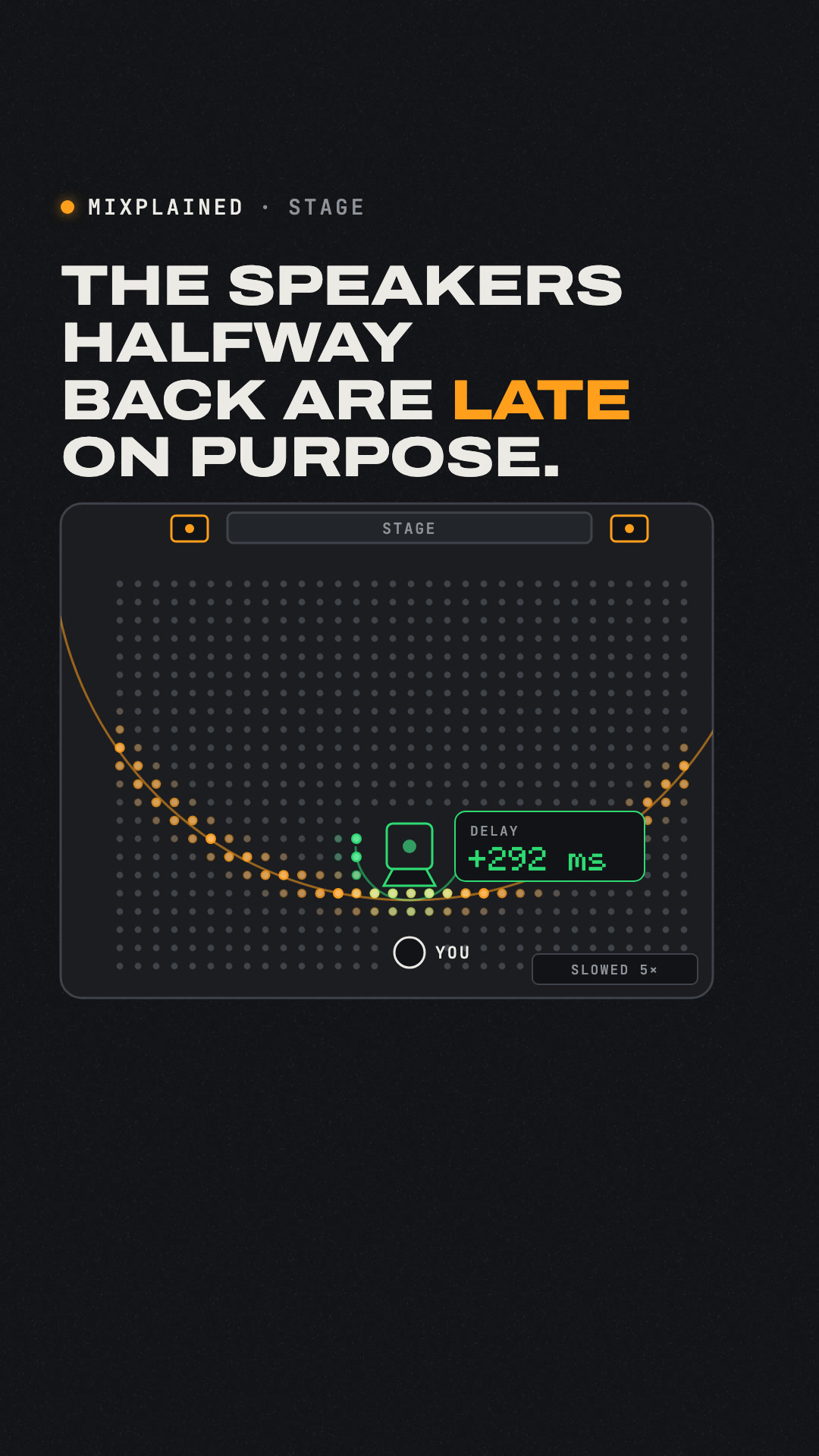
Why the speaker towers out in a festival field play late on purpose: sound needs about 0.29 seconds to cover 100 metres, so the towers wait for it.
Late on purpose. Right on time.
Facts
- Sound travels about 343 metres a second in air at 20 °C – about 2.9 milliseconds per metre – so it needs about 0.29 seconds to cover 100 metres.
- Delay towers are speakers out in the crowd playing the same mix as the main PA. Their signal is delayed electronically so it lines up with the sound arriving from the stage, which keeps the back of the field loud without blasting the front.
- Without the delay, people near a tower 100 m out would hear it about 0.29 s before the stage – far more than the few tens of milliseconds our ears blend into one sound – so every kick would echo.
- Engineers often add a few milliseconds more (sources suggest roughly 10–20 ms) so the main PA arrives first and the sound still seems to come from the stage; some system designers aim for exact alignment instead.
- Sound gets about 0.6 m/s faster per °C, so a cooling evening shifts the timing by roughly 0.5 ms per degree over 100 m; engineers advise re-checking delays when temperatures swing.
- Main-stage delay towers often stand about 50–70 m from the stage (Sound On Sound); at Glastonbury 2013 the Pyramid Stage's four delay masts stood 100 m back.
Sources
- University Physics Volume 1, 17.2 Speed of Sound · OpenStax (Rice University) checked 6 October 2026
- The Physics Classroom: The speed of sound · The Physics Classroom checked 6 October 2026
- Sound On Sound: Jon Burton – Outdoor sounds, engineering sound for festival events (2012) · Sound On Sound checked 6 October 2026
- Martin Audio: RG Jones and Martin Audio at Glastonbury (2013) · Martin Audio checked 6 October 2026
- Smith & Detsky: Adaptive Delay System (ADS) for sound reinforcement (Canadian Acoustics, 2004) · Canadian Acoustics checked 6 October 2026
- QSC Sound Advice: Loudspeaker placement part 7 – using delayed loudspeakers · QSC checked 6 October 2026
- QSC: What is the Haas effect and how to take advantage of it (2021) · QSC checked 6 October 2026
- NTi Audio: Haas effect · NTi Audio checked 6 October 2026
- Brown, Stecker & Tollin: The precedence effect in sound localization (JARO, 2015) · Journal of the Association for Research in Otolaryngology checked 6 October 2026
- Merlijn van Veen: To delay or not, that is the question (Live Sound International, 2017) · Live Sound International checked 6 October 2026
- ProSoundWeb: What’s the delay? The effects of weather conditions on sound (Bruce Main, 2015) · ProSoundWeb checked 6 October 2026
- d&b audiotechnik: A staggering d&b system supports World Youth Day 2016 · d&b audiotechnik checked 6 October 2026
Example field and figures: every site is measured and timed on the day.
All sound is original: synthesised for the episode, no samples, no licensed tracks. The narrator’s voice is AI-generated. General information. Features differ by software, player and version – check your own manual. Read how facts are checked and corrected.
Script
The speakers halfway back are late on purpose. Sound is slow: about 343 metres a second. To reach a tower 100 metres out, it needs 0.29 seconds. Play the tower live, and back there you'd hear every kick twice. So the tower waits: its signal is delayed to match the sound from the stage. Often a few milliseconds more, so the stage lands first and still sounds like the source. As the night cools, sound slows, so engineers re-check the delays. Late on purpose. Right on time. Follow for the next cue.
Sources last checked 6 October 2026.